Friday, July 29, 2011

Australian Royal Botanic Garden


We've had an excellent time in Melbourne so far, and one of the highlights was a visit to the Royal Botanic Gardens located right in downtown Melbourne. This sprawling garden is packed with winding paths, grassy lawns, and lush forests for visitors to explore. The collection of native plants is impressive, and includes lots of tree ferns like the one shown above. It's mid-winter here right now, but many plants are still flowering, since it gets chilly here in the cold season but not particularly harsh. Photos of a very small selection of the species present in the garden are below; some don't have names as I couldn't find labels on them and I'm not all that familiar with the Australian flora!

Succulent garden

Acacia sp.; Ceiba insignis

Pathway through the garden

Clematis sp. (?); unknown

Sunday, July 17, 2011

Australia!

Posts have been scarce this summer as I've been busily working on writing my PhD thesis. I get a break from writing next week, though, as I'll be heading to Melbourne, Australia to attend the International Botanical Congress and explore the state of Victoria. IBC happens every six years in a different part of the world, and I'm looking forward to the opportunity to visit a new (for me) part of Australia - I studied abroad in Brisbane and got to visit Sydney and the Center during my five-month stay there in 2004. I will also be talking about my dissertation research in a symposium on fern biology at the conference, which will be a great opportunity to get feedback and discuss my research with an international cadre of plant scientists. Following the conference I will be traveling with my lab around Victoria for a few days, and hopefully finding some ferns. Stay tuned for photos and posts from the trip!

Wednesday, June 22, 2011

Dryopteris expansa


My most exciting fern find so far this year has definitely been locating Dryopteris expansa in northern Wisconsin. This is the only species which I should have been able to find a field site for, but have failed at finding for the last couple of years. I've seen D. expansa out west, in Washington and Oregon, but I need a site within driving distance to make the types of measurements I need for my research. This species is well-documented in northern Wisconsin and Michigan, but somehow I was never able to track down any of those populations, or they were gone from the sites where they previously occurred. But now, finally, with the help of some very nice folks from the Chequamegon-Nicolet National Forest, I've got not one, but two field locations of D. expansa! I will probably only be returning to one to make measurements in the next few weeks, but it's nice to know that the other is there.


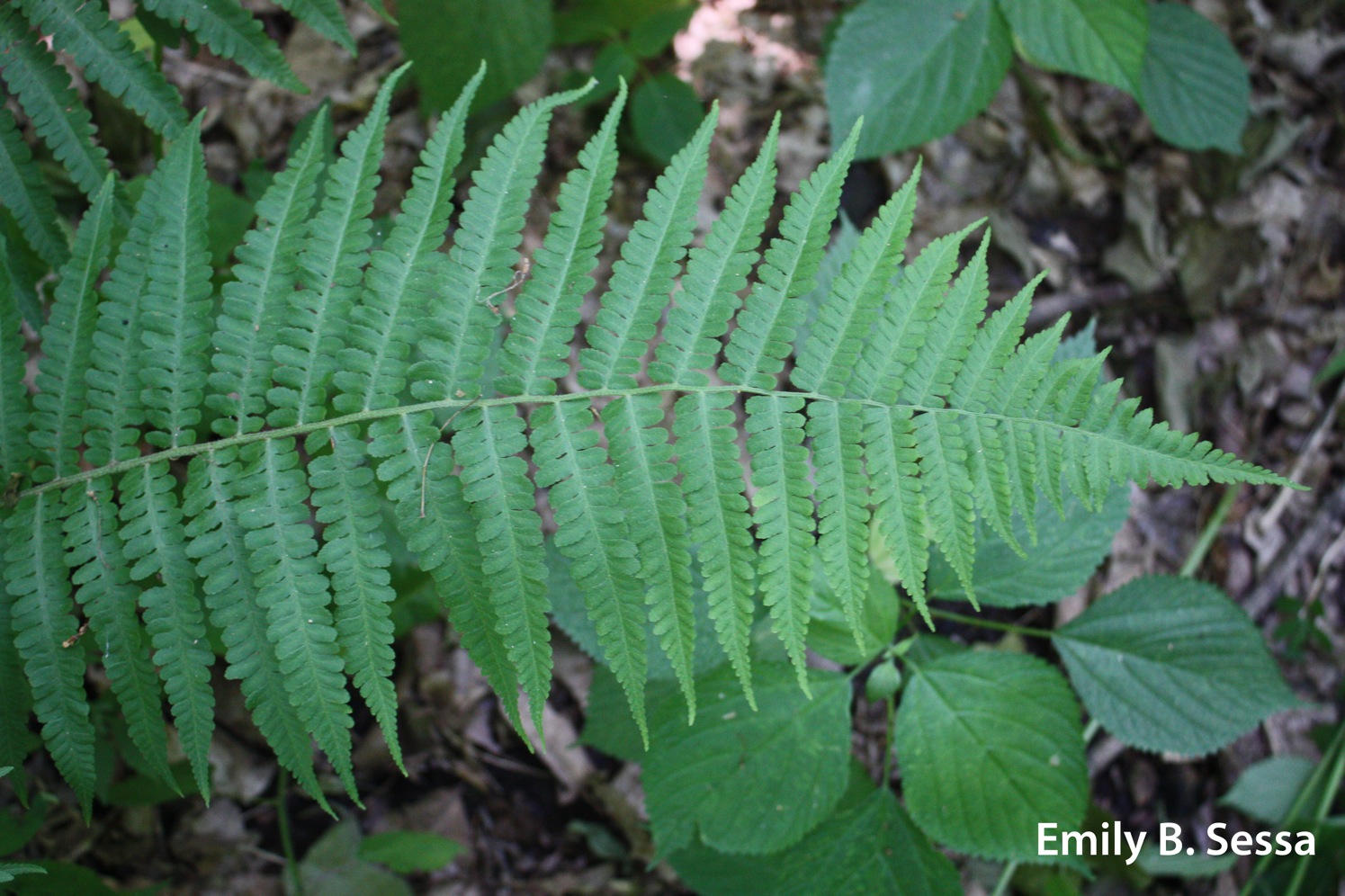
Like most Dryopteris, D. expansa is several times divided, and has a typical lacy, 'ferny' look to it. It's beautiful, needless to say. One stand-out character of this plant is the lowermost pair of pinnae, which are hugely triangular and expanded at the based (hence the species' specific epithet). The first innermost pinnule on the bottom (called basiscopic) is always the longest, as opposed to some other species of Dryopteris, where it is either always shortest, or varies considerably. The primary reason I was so anxious to find this species is that it is a diploid, and is one of two parents of a polyploid species called D. campyloptera. There are five sexual polyploid Dryopteris in the North American flora; of these, two have one parent that is unknown and probably extinct, leaving only three polyploids with both parents extant. Part of my work involves comparing the polyploids with their putative parents, and this is a very small sample size! So you can understand why finding this fern was so important to me - it was the only diploid parent of those three polyploids that was missing, so I now have the complete set for all three!


I'm measuring a number of characters related to light relations and photosynthesis for my research, and here's a shot of my photosynthesis equipment hard at work work on D. expansa:

Monday, June 20, 2011

Deparia acrostichoides


I mentioned in the post on Abraham's Woods ferns that we found a new species there (well, new for that site): Deparia acrostichoides, the Silvery Glade Fern. I got some better photos of it on a return trip and thought I'd share some more about how to identify this fern. It actually sort of resembles Dryopteris goldiana, which it grows right alongside. Both are twice pinnate, but a major difference is that the pinnule lobes of Deparia are blunted and round-ended, while the Dryopteris pinnules come to a point (see photos in previous post).


Another character is the hairs: as you can see in the photo below, Deparia has a dense covering of white hairs, which make it look decidedly fuzzy, and it has no real 'scales' to speak of:


This final shot is of the underside of a frond, which is where the sori should be. Strangely, though, I couldn't find a single frond in the entire population which was fertile. All the other ferns I've seen this year are fertile by now, although the sori are still immature, but this Deparia is totally lacking in reproductive structures. I can't find any information on when it becomes reproductive; maybe this species is just a late bloomer, so to speak. A late sporer? I will be visiting this site again in the next few weeks and I'll keep an eye on it. In any case, this genus is distinguished by having linear sori, similar to Lady fern, along the midveins (costules) of the pinnules.


Wednesday, June 15, 2011

Dryopteris goldiana at Abraham's Woods


I did a post about most of the ferns at Abe's Woods a few days ago, but I wanted to save Goldie's Woodfern, Dryopteris goldiana, for its own post. This species is close to my heart, since it's one of the (relatively) rarer members of the genus I study, and the population at Abe's Woods is really beautiful, and extensive. We saw it when we visited a couple of weeks ago, and the ferns were still unfurling, with many still in fiddlehead stage. I just went back to put out dataloggers, since I will be using this site for my research, and what a difference a few weeks makes! We've had a very strange, late spring here, and the temperature has gone from mostly in the 40s to mostly in the 90s over the last four weeks, and the ferns have responded in force.D. goldiana is one of the largest ferns we have in the woods around eastern North America (it could go toe-to-toe with Ostrich fern for that title), and it's remarkable to see how much they've grown and how quickly. Above and below are some 'before' shots...


And here are the 'after' shots. Quite a difference, huh?


These ferns are also showing off some helpful diagnostic characters. If you happen to come across an absolutely gigantic fern in the woods, and for some reason you're not totally convinced that it's Dryopteris goldiana just based on its massive-ness, here are a few things to look for. First, this species tends to have dense brown or golden-brown scales along the stipe (typical of the genus), but D. goldiana has a definite dark stripe down the middle of the scales, while many of the other Dryopteris I've come across in our area don't have this stripe. The arrangement of the sori is also pretty striking. They're very orderly, arranged in rows down either side of the costule of each pinnule, and have the typical Dryopteris form: a kidney-shaped, reniform indusium covering each sorus. Again, the only other really large fern you could confuse this with might be Ostrich fern, Matteuccia struthiopteris, but that one has totally dimorphic, separate sterile and fertile leaves, so should be easy to separate from this Dryopteris.


I included this last photo just to further impress you with the size of this critter, and I actually took a similar photo with Dryopteris celsa, the log fern, which is a polyploid between D. goldiana and D. ludoviciana. You can certainly see where D. celsa gets its size from!


Saturday, June 11, 2011

Leafsnap


I've done some posts before about field guides, and I wanted to spread the word about a really neat new tool which is available for identifying trees. It's called LeafSnap, and it's an app for iPhones and iPads (they also have a website, which has all the same information as the app). This thing is really cool - it was developed jointly by the Smithsonian, Columbia University, and the University of Maryland, and it's one of the most comprehensive photographic field guides I've ever seen. Here's a sample of the photos it has on each tree's page, for the 182 species it knows (this is a screenshot taken from their page on Castanea dentata, the American chestnut):


Leaves, fruits, flowers, bark - it's all there. The neatest thing about it is that if your device has a camera built in, like the iPhones, iPod touches, and iPad 2 do, you can take a photo of a single leaf and the app will identify the tree for you! I spent a while walking around my neighborhood today taking photos of leaves, and it does a darn good job of telling what's what. It's not foolproof - for each leaf I uploaded, it gave me a selection of possible species, and in some cases the correct one was #4 or 5 on the list. But for a photo taken with a smartphone and possibly belonging to one of hundreds of species, that's not bad at all. It keeps track of all the trees you've identified in a "collection" on your device(s), and you can also look at a map to see where all your species are. The best part: it's FREE!! I can't even imagine how much work must have gone into creating this, and it's amazing that there's no charge for the app.

Actually, it's not so amazing - the project was funded in part by an NSF grant, otherwise known as our tax dollars. I think it's important to point this out because this is a phenomenal educational tool, that hopefully will encourage people to take more notice of the plants around them and inspire them to learn more about the natural world. It's a terrific way to merge a traditional field of science like botany with new technology to make something fun and functional. I'm thrilled to know that my tax dollars went to pay for this project and I wish more money went to support forward-thinking educational endeavors like this. I assume it's offered for free as a stipulation of receiving federal monies.

I should also mention that this app is geared for the Northeast - the default locations are Washington D.C., New York, and Northeast (last I checked New York was in the Northeast, but whatever). But I'm using it in Wisconsin and it's doing just fine!

Friday, June 10, 2011

Final flowers...


I promise this will be the last flower post for quite awhile, as most of the spring flowering angiosperms have done their thing and are now strictly vegetative. I couldn't resist sharing one more batch of flower photos, though, since these are from quite a different habitat than the rich woodlands where the photos in my other recent flower posts were taken. These plants are all from Muralt Bluff Prairie, an open-access hilltop prairie just around the corner from Abraham's Woods in southern Wisconsin. This is a really neat place, exposed and windswept, with an interesting assortment of prairie plants. It had recently been burned before our visit, so a lot of things were just starting to poke out for the spring. Pictured above is Prairie Smoke, Geum triflorum, and it covers an entire slope on the western edge of the prairie:


Also on the western side, near the bottom of the hill, is this rare beauty, Besseya bullii, or Kittentail, not to be confused with the also-yellow-flowering Lousewort, Pedicularis canadensis, which is in the two photos below the Besseya.


And no set of spring floral posts in Wisconsin would be complete without a shot of Pasque Flower, Anemone patens: