I leave Thursday for Washington, DC, where I will be doing a fellowship at the Smithsonian Institution for several weeks over the course of the summer. It should be a fantastic experience, and I'm looking forward to working with some great people in the fern community while I'm there. I will post as often as I can about working with and collecting ferns in the DC area, and hopefully I'll have some good stories to tell along the way. Wish me luck!
Tuesday, June 24, 2008
Dryopteris marginalis
Thursday, June 19, 2008
Dryopteris sori IV: D. carthusiana
The last post in this mini-series (for now at least) on Dryopteris sori: D. carthusiana, the Spinulose or Toothed Wood Fern. It is a close relative of D. intermedia, which is one of its parents. D. carthusiana's other parent, however, is unknown, but is posited to be a mythical beast known as "Dryopteris semicristata", always written in quotations because it has never been seen and is therefore only hypothetical. This fabled fern, which many pteridologists have hunted but none have found, is also a parent of D. cristata, the Crested Wood Fern. I think The Quest for Semicristata would be a good subtitle for the next Indiana Jones installation, or perhaps just a chapter heading in my thesis one day.
Dryopteris sori III: D. clintoniana
More Dryopteris sori, this time from Clinton's Wood Fern, Dryopteris clintoniana. These plants were growing up to three feet tall around the edges of a swamp in McLean, New York, near Ithaca.
Dryopteris sori II: D. marginalis
One more Dryopteris post tonight. This is Dryopteris marginalis, the Marginal Wood Fern, so named for the sori that are found along the margins of the pinnules, as you can see in the top two photos. D. marginalis is perhaps my favorite species in the group; its sori are beautiful and make it easy to identify, and the fronds range in hue from a bright green to an almost iridescent bluish color. The lower photos show two lovely crown-shaped specimens in dry, rocky woods atop Glass Mountain in South Carolina.
Dryopteris sori I: D. intermedia
I've been remiss in blogging during the past few weeks due to lots of time spent in the car, crossing large swaths of the country. But it was worth it for the ferns! I saw a lot of beautiful things down in Virginia and the Carolinas, and I think it's time I do a post (or several) on the group I actually study: Dryopteris, or the Wood Ferns. There are approximately 250 species of Dryopteris worldwide, with 14 or so here in North America. They are exceptionally beautiful ferns, and I decided to start with some of their loveliest features: their sori. The fern pictured above is Dryopteris intermedia, grown in the gardens at Crow Dog Native Ferns from wild-collected spores. The indusia are the whitish clamshells, and the shiny black sporangia peeking out from beneath them indicate that the spores are ripe and ready to dehisce. This would be the perfect time to collect spores from this plant to sow and grow.
Saturday, June 7, 2008
Osmundastrum cinnamomea
This genus is also interesting because it has been recently renamed. It is a member of the family Osmundaceae, which also includes the common Interrupted Fern (Osmunda claytoniana, subject of a previous post) and Royal Fern (Osmunda regalis). Until recently, Cinnamon Fern was included in the same genus as these two, but was reclassified into its own genus, Osmundastrum (making it Osmundastrum cinnamomea) after a January paper published in the journal Systematic Botany.
Sunday, June 1, 2008
Sori, I didn't see you there
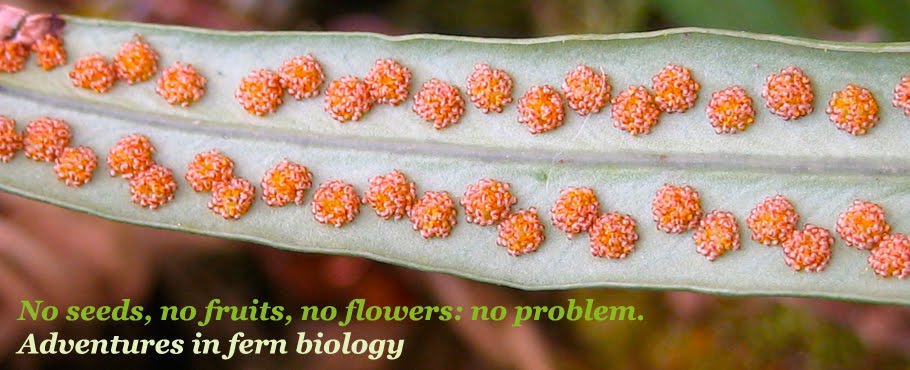
Sori are often round (as in the first, third, and last images, of Campyloneurum, Niphidium, and Tectaria, respectively), but may also be linear (second and fourth, Adiantum and Pteris), and some groups of ferns have more complex cup-shaped or valved sori. Another important structure when considering sori is the indusium, a piece of tissue that may sit on top of or surrounds the sorus. To complicate matters further, some ferns, like the Adiantum pictured in image #2 at top right, have what is known as a false indusium; their sori are surrounded by an indusium-like flap, but it is not derived from the same source as a true indusium.
The presence and shape of the sori, and the presence or absence of indusia, are some of the most important characters to consider when trying to identify a fern, as they are very often specific to families or genera, or even to a certain species. For example, all members of the genus Adiantum have a false indusium that is simply the edge of the leaf rolled over the sori, and this single diagnostic feature is extremely helpful in positively identifying a fern as a member of this genus.
Well-meaning but uninformed folk sometimes mistake sori for fungal or insect infections on leaves, and scrape them off thinking that they're doing the plant a favor. Big mistake! Doing so could potentially destroy a fern's entire reproductive output if the scraping were thorough enough. And besides, then you couldn't enjoy looking at them anymore.
Subscribe to:
Posts (Atom)