


This unfurling process of the tightly-curled leaf is called circinate vernation. Circinate refers to the circular or ring-shape of the fiddlehead, and vernation comes from 'vernal' (meaning 'spring'), when new leaves tend to emerge. By remaining tightly rolled up, the growing tip of the leaf is protected during emergence, and this protection is often supplemented by thick hairs or scales that cover the fiddlehead, as you can see in some of these photos. You can also see that the lateral leaves are in fiddlehead-form too, just as the tip is.
Wednesday, February 20, 2008
Fiddleheads

Friday, February 1, 2008
Thelypteris


Thelypteris is a common fern in North American woods and wetlands. Thelypteris palustris, the marsh fern, and Thelypteris novaboracensis, the New York fern, are pretty typical-looking ferns that most people have probably seen but not really noticed...
Wednesday, January 30, 2008
Nephrolepis

I have returned from the beautiful, balmy mountains of Costa Rica to the frozen hellscape of Madison, WI, where during my absence there was a week when the temperature didn't go above 8 degrees Fahrenheit. Glad I missed that, although today's -1 isn't proving too pleasant either. Given the bone-numbing weather I find myself pining for Costa Rica's beautiful ferns, so I will focus on them for a few posts.
This beauty is a species of Nephrolepis, a genus in Polypodiales that is characterized by, among other things: an apex that remains curled in a fiddlehead, and articulate pinnae that fall off the rachis. The popular house plant Boston Fern is a species of Nephrolepis, but it tends to leave a mess behind when it decides to shed its pinnae. This one was growing as an epiphyte in a rainforest preserve, called Braulio Carrillo, which we visited on the return trip from La Selva to San Jose.
Saturday, January 19, 2008
Campyloneurum
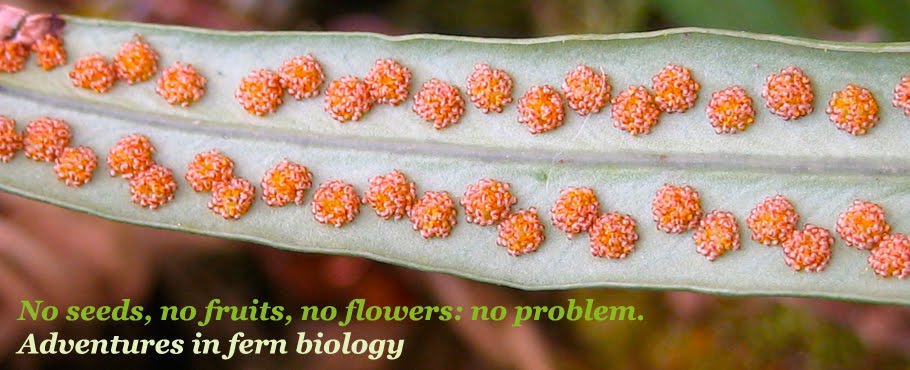
In this inaugural blog post, it seems appropriate to talk about the fern I've chosen for my header image. It is a species of Campyloneurum from Costa Rica, where I'm currently taking a course on Tropical Ferns & Lycophytes through the Organization for Tropical Studies, a consortium of colleges and universities from around the world.
Campyloneurum is a genus in the Polypodiaceae, and this species was collected at Las Cruces Research Station, which is maintained by OTS near San Vita, Costa Rica, close to the Panamanian border. Campyloneurum is an epiphyte with simple, entire leaves, veins that form a net (said to be anastomosing), and round sori that lack the covering called an indusium which is found over each sorus in many ferns. In this picture each large round clump is a sorus, and the smaller orange glassy-looking things that are piled up to make it are the sporangia. These contain the spores, and they will dry and split open when the spores are mature and ready to be dispered.
Campyloneurum is a genus in the Polypodiaceae, and this species was collected at Las Cruces Research Station, which is maintained by OTS near San Vita, Costa Rica, close to the Panamanian border. Campyloneurum is an epiphyte with simple, entire leaves, veins that form a net (said to be anastomosing), and round sori that lack the covering called an indusium which is found over each sorus in many ferns. In this picture each large round clump is a sorus, and the smaller orange glassy-looking things that are piled up to make it are the sporangia. These contain the spores, and they will dry and split open when the spores are mature and ready to be dispered.
Subscribe to:
Posts (Atom)