Wednesday, August 13, 2008

Thelypteris qualpaertensis


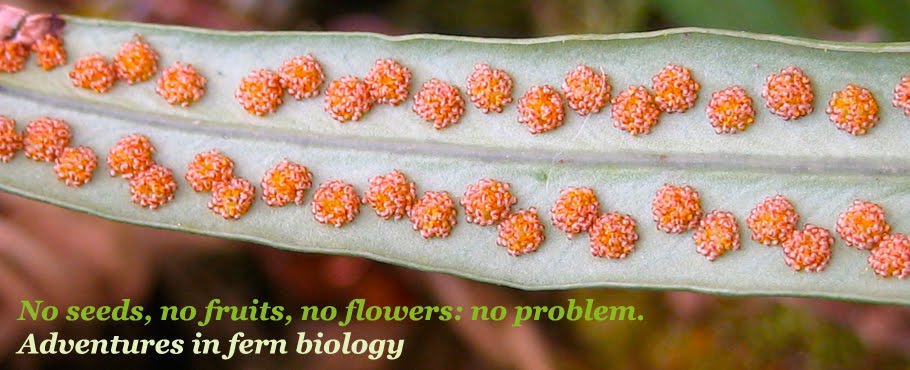
I decided to start the fern role-call with this species, a new one for me, mostly because it's got a cool name: T. qualpaertensis. The etymology of scientific names is a hobby of mine, but here I'm stumped. I have no idea what it means, as my Botanical Latin book is back home in Wisconsin while I'm here in DC. T. qualpaertensis looks like most Thelypterises I've come across, and I was particularly enchanted by its sori, which looked to me like little blackberries.

Vancouver and Beyond


The ferns have kept me busy the last few weeks, so it's been a while since my last post. I'll try to make up for that, starting today. I'm back in DC after spending several weeks traveling and enjoying the plants of the Northwest Coast, an area of the US and Canada where I've never been before. I attended the Botanical Society of America's annual conference at the University of British Columbia in Vancouver, Canada, and then spent several days traveling around Washington and Oregon with local fern aficionados.

This post serves as a (very brief) introduction to the types of habitats and plants I saw out there, and I'll follow it up with several entries about specific ferns I encountered.

The pictures above are from a fern foray that took place Saturday, July 27th, to the Lower Seymour Conservation Area and Mount Seymour, north of Vancouver. There are usually several field trips on the weekend preceding the Botany conference each year, and the fern ones are always the most fun (of course). On this trip we visited typical conifer forest at the Conservation area, and as you can see, there were tons of ferns. The ones most prominent in these photos are Athyrium filix-femina (Western Lady Fern) and Blechnum spicant. I'm bad at trees, so I don't know the species that were present, but suffice to say there were lots of them, and they were BIG.

The forest was pretty rich and dense with plant life, including mosses that were draped over many of the branches. Surprisingly, despite the lush coverage of ferns, the fern flora was fairly depauperate (meaning number of species, not abundance of plants). Earlier this summer I was able to locate 15 fern species on just two or three acres at my parents' home, while my list topped out at around 10 species for this incredible forest. It's likely that there just aren't a ton of ferns able to cope with the relatively low water availability imposed by the long winters in this area of the world.
Sunday, July 20, 2008

Oaxaca Journal by Oliver Sacks


I was scandalized last week to learn that for the several years now, an amalgam of two of my favorite things has existed and I knew nothing about it. In 2005 (that's three years ago!) Oliver Sacks, an author most dear to my heart, published this slim volume entitled Oaxaca Journal, a chronicle of  — wait for it — a ten-day fern foray he joined in 2000 to Oaxaca, Mexico. Organized by the American Fern Society, the foray was exactly what it purported to be: a group of pteridophyte enthusiasts searching out plants in the fern-rich environs of Oaxaca. Sacks is a self-professed life-long lover of ferns, and has been a member of the New York chapter of the Fern Society for many years. Needless to say, the moment I discovered this book existed, I ran out and bought a copy. The journal is typical of his wonderful, engaging writing style, and I highly recommend it as a short, highly enjoyable, and very affordable ($8.76 from Amazon.com) read. 

Thursday, July 17, 2008

Online Fern Key


Back to fern-focused posts. For anyone who lives in Wisconsin, or most of the midwest or northeast for that matter, this guide to the pteridophytes of Wisconsin is a great resource. Hosted by the Cofrin Center for Biodiversity at the University of Wisconsin-Green Bay, the site features an interactive, dichotomous key to the ferns and "fern allies" of the state, as well as a checklist of Wisconsin ferns and a glossary of fern terminology. Really helpful if you want to learn more about how to identify the species you might come across in this part of the country.

Tuesday, July 15, 2008

A Female! Ready to Mate!

One more non-fern post for tonight. I just discovered this series of short films called Green Porno at the sundance channel site. They are written/directed/star Isabella Rossellini as a variety of insects and arachnids, explaining their sexual practices in about 30 seconds. They are very imaginative and intriguingly done and I enjoyed watching them.

Teach the Controversy


A non fern-related post: I just learned about these awesome t-shirts for sale by Amorphia Apparel. I will probably buy more than one, even though I don't really like t-shirts. They have a Teach the Controversy line, picturing absurd scenarios along with the flogged-to-death garbage line impelling you to "Teach the Controversy," as well as a Science! line that features, among other things, a cowboy-hat wearing, labcoat-sporting scientist astride a galloping paramecium. Yippee kayay!

Ferns on the Mall


Greetings! It's been a long time since my last post. My work at the Smithsonian has kept me really busy, but we're making progress! Unfortunately I haven't done any ferning or field-tripping since I've been here, so I have no new pictures of ferns in the wild, but I did come across some ferns in a most unexpected place: the National Mall. I happened to look up from my book one morning while on the shuttle, and there, right in front of the Smithsonian Castle, where these benches! They looked really familiar, and sure enough, they are replicas of the 1870 Fern and Blackberry garden seat I wrote about several months ago. There's actually a website that discusses the various outdoor furnishings in the Smithsonian gardens, but alas, it doesn't mention these benches explicitly, only citing them as illustrative of the "naturalistic" period of furnishings. I'll have to make up my own story about how they were chosen (involving some clear-eyed visionary who recognized the beauty, modesty, and steadfastness of ferns and felt that they were a perfect symbol to sit before a great repository of knowledge).

I'm afraid I won't have many more opportunities for fern-viewing until late July, when I go to Vancouver, B.C., Washington State, and Oregon, for the annual Botanical Society of America conference and some time in the field. The blog will likely be light until then, as I wrap up this stint in D.C. and head home to Madison. I should have a lot to write about once that next trip begins!