Showing posts with label fern general. Show all posts

Saturday, April 26, 2014

Splinter Hill Bog: Ferns!

Bracken and pine in a recently-burned section of the bog tract.
I've saved a post about the ferns of Splinter Hill Bog for last! We saw several species on our trip, in various stages of early spring loveliness. The common species included Osmundastrum cinnamomeum (cinnamon fern), Osmunda regalis (royal fern), Woodwardia virginica (Virginia chain fern), and of course the ubiquitous Pteridium aquilinum (bracken fern).
Woodwardia virginica
Pteridium aquilinum
Osmundastrum cinnamomeum
Osmunda regalis
Osmunda regalis
Osmunda regalis

Tuesday, April 15, 2014

Neochrome evolution in ferns

Photo by Fay-Wei Li, via phys.org
Some very exciting new research on fern evolution was just published in the Proceedings of the National Academy of Sciences! Researchers have known for years that ferns possess a chimeric photoreceptor, called neochrome, that allows them to use both red and blue light for photosynthesis. This is a significant advantage in forest understories where blue light has often been filtered out by overhanging leaves of taller plants. In the new paper published yesterday, a team of researchers led by Fay-Wei Li at Duke has discovered that neochrome in ferns is actually most closely related to neochromes in hornworts, and that it likely passed from hornworts to ferns via horizontal gene transfer about 179 million years ago. The timing of this event suggests that this transfer, and the low-light photosynthetic ability it conferred on ferns, allowed them to subsequently diversify "in the shadow" of angiosperms, as the latter exploded in diversity starting around 120 million years ago. This is a really cool finding, and expands our understanding of fern evolution and diversification tremendously!

Check out more coverage of this story in the Economist:
Time and change: The survival of ferns to the present depended on an ancient accident

And at Phys.org:
Ferns borrowed genes to flourish in low light

And read the abstract of the paper here (subscription to PNAS required for full article):
Horizontal transfer of an adaptive chimeric photoreceptor from bryophytes to ferns

Monday, August 19, 2013

Fern Field Trip at Botany

There is always a fern field trip at the annual Botany conference, and this year was no exception. These trips are a wonderful way to visit new places, see lots of ferns, and catch up with old friends. I look forward to them every summer. This year's trip took us west and a bit south of New Orleans, eventually to Avery Island, the home of Tabasco Sauce, among other things (gators, egrets... see below). We didn't see a huge number of fern species, but there were some exciting items on our "spotted" list, including Ceratopteris pteridoides, a close relative of the nearest thing we have in ferns to a model species - Ceratopteris richardii. I've never seen any Ceratopteris in the field before, so that was a fun siting. Here's the full list of species we saw, at least by my count:

  • Asplenium platyneuron
  • Azolla caroliniensis
  • Ceratopteris pteridoides
  • Equisetum hyemale
  • Lygodium japonicum
  • Pleopeltis polypodioides
  • Polystichum acrostichoides
  • Salvinia minima
  • Thelypteris palustris
  • Thelypteris dentata

And some photos of the ferns and folks that day:
Fay-Wei Li  and Mike Barker with Ceratopteris pteridoides
Ceratopteris pteridoides
Azolla caroliniensis

Pleopeltis polypodioides
Asplenium platyneuron
The following photos are of Lygodium japonicum... a terribly invasive fern in parts of the southeastern U.S., but I have to admit that I have always found it awesome looking. There are relatively few true vining ferns, and the Lygodium species are among them. They have dimorphic leaves, with the fertile and sterile pinnae looking decidedly different (lower photo). There is also a native species, Lygodium palmatum, which I've seen in South Carolina.


 And always a great find - a gametophyte and baby sporophyte! ID unknown, even by the experts with us.
Tiny sporophyte emerging from remains of a gametophyte
Finally, no field trip in the southeast is complete without alligators, apparently. There is a beautiful egret rookery on Avery Island that we stumbled upon as we rounded a corner - the trees in this swamp were filled with hundreds of snowy white birds (not sure, actually, if they were Snowy Egrets or another species). After admiring them for a few minutes we noticed that several log-like objects were moving through the water towards our party - never a good sign down in these parts. These were smallish gators, and were satisfied with watching us closely (as they usually are), though they swam alongside us at our walking pace as we turned to leave, like a reptilian escort away from (undoubtedly) their nesting grounds. Creepy. I wouldn't be an egret in that swamp if you paid me.


Tuesday, August 6, 2013

Botany 2013 conference in New Orleans


Last week was the Botany conference, an annual coming-together of plant scientists hosted by several professional societies including the Botanical Society of America, American Society of Plant Taxonomists, and American Fern Society. Botany is always a great place to catch up with old friends and colleagues, establish or check in on collaborations, and immerse oneself in all things plant science for about a week.


Don Farrar, Iowa State University
Emeritus professor

This year the meeting was held in New Orleans, and it was particularly wonderful, partly because I got to see many dear friends from Madison and grad school. At last year's conference I had just left Madison a few weeks prior, but now a year has passed and I hadn't realized how much I missed all those folks until we were reunited in NOLA. In addition, there were several great symposia and colloquia this year, including two focused on polyploidy, and the usual highlights of the Fern Society/Pteridological Section activities. This year these included the usual fern field trip on the Saturday preceding the conference (to be covered in another post), the standard Pteridological Section half-day of talks and American Fern Society lunch, and also a special colloquium called Frontiers in Fern Gametophyte Research (link goes to the schedule of talks). This was organized by my friends and collaborators Eddie Watkins and Josh Der, and it was great! The talks focused on various aspects of current fern gametophyte research, including physiology and light relations, hormones, chloroplast movement, and the issues involved in outbreeding when you have underground gametophytes, a challenge faced by members of the genus Botrychium. The Botrychium talk was given by Don Farrar, who was also the honoree of the colloquium - he has long worked on Botrychium (pictured below) and gametophytes, and for just as long has been an inspiration and friend to the entire fern community.


Another exciting, though more sober, happening at the meetings was a session called "Yes, Bobby, Evolution is Real!", a not-very-subtle callout of Louisiana's governor, Bobby Jindal, and Louisiana's blatantly unscientific Louisiana Science Education Act (LSEA), which mandates teaching "alternative explanations" for the origins of Earth's diversity. The session was picked up by many local news outlets and made its way to the HuffingtonPost, in an article that received over 5600 comments in less than 24 hours. Another Botany attendant and friend, Dr. Chris Martine, beautifully summarized the hubbub about the session and some of the relevant issues in evolution education in his own column at HuffPo. It's not often that Botany makes the headlines in such a big way, and I'm glad the conference contributed to this important discussion about the future of science education in America.

Monday, March 4, 2013

Apomixis in ferns

I've been reading an interesting article published last year (2012) in the Journal of Botany (here; subscription required) on "The Evolutionary Dynamics of Apomixis in Ferns". Apomixis is a really interesting process of asexual reproduction that is fairly common in ferns, and involves modification of two critical steps in the life cycle. First, when the sporophyte produces spores, this usually occurs via meiosis and is accompanied by a reduction (by half) of the total number of chromosomes. So if you happen to be a fern in the genus Dryopteris, with a base chromosome number of 41, your diploid sporophytes will have 82 chromosomes, and this will be reduced to the base of 41 during meiosis. If that reduction does not happen and your spores retain the full complement of chromosomes, that is known as diplospory. Those spores will then germinate into gametophytes, and rather than producing eggs and sperm via archegonia and antheridia, respectively, which go on to perform fertilization and sexual reproduction, often no sexual structures are produced at all, and new sporophytic tissue will arise from somatic (body) cells of the gametophyte itself (known as apogamy).

Apomixis and apogamy have long interested botanists because they get at a fairly fundamental question in the evolution of life - is it better to be sexually reproducing or asexually reproducing? There are advantages to both strategies, and I will do a tremendous amount of boiling down here to summarize them thus: sexual reproduction involves many processes that tend to shuffle genetic material and will lead to increased genetic diversity, which will provide raw material for natural selection. If your particular genetic makeup is well-suited to your current environment, mixing things up might not be advantageous, and reproducing asexually will be more likely to allow you to maintain the status quo. As environments change, however, having additional variation will improve the changes that a new genetic combination will be better suited to the new environment. There is a lot more to the story than this, and a huge literature on apomixis and apogamy in flowering plants, and to a lesser extent in ferns, if you're interested.

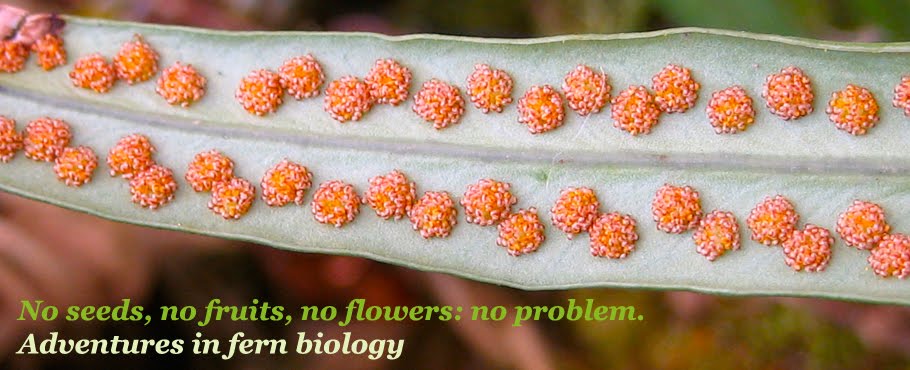
The authors of the paper I mention above have also put together a website summarizing what's currently known about apomixis in ferns, including a complete list of fern species known to be apomictic. It's a great resources if you're interested in fern reproductive strategies! Here's a shot of the site:

Sunday, February 24, 2013

Finally, ferns!

You may have noticed that for a blog about ferns, fern-centric posts have been sparse here since last summer. That coincides with my move to Tucson, Arizona, and the sad fact is that I just haven't found that many ferns in the desert. I know they're here! But they aren't as easy to find as in other climates. However, I'm happy to say that I've gotten a fern fix! I just had the opportunity to spend a few days in northern Florida, and even in late February things were lush and there were ferns out in force (I'll cease the letter f-based alliteration now).

There were three ferns I kept running into during my visit, and they're a combination of things that are common in the southeastern U.S. (Thelypteris sp. and Pleopeltis polypodioides), and in subtropical/tropical climates generally, at least in the New World (Nephrolepis sp.). Here they are:

Thelypteris sp.:

Pleopeltis polypodioides:

Nephrolepis:

There are actually several species of both Thelypteris and Nephrolepis found in Florida, including a hybrids of both (my favorite things!). You may recognize Nephrolepis if you have a "Boston Fern" as a houseplant; it's the same genus, and the original Boston fern belongs to Nephrolepis exaltata, which is a frequent escapee in congenial climates. There's a great explanation of the Nephrolepis species of Florida, along with a detailed key, in the July/August 1996 edition of the FL Department of Agriculture and Consumer Services' Botany Circular. That link goes straight to the PDF. Unfortunately I didn't find this before leaving, so I didn't have a chance to confirm which species I was looking at, but I strongly suspect that it was N. exaltata.

And of course, it wouldn't have been a proper visit to Florida without a gator sighting:

Monday, August 22, 2011

Australian ferns: part III

In keeping with my trend of decreasing in size with these fern posts, this last one focuses on the truly tiny: gametophytes that we found growing on moist soil banks. Gametophytes are the free-living haploid stage of the fern life cycle, and in temperate climates they're usually pretty challenging to locate, since they're small, relatively ephemeral, and look just like mosses. In the tropics it's considerable easier to find them, and as soon as we started to hunt for them they started to pop out of the background. The photo above shows a large clump of gametophytes that may actually a single plant, or a bunch clumped together. That's a bit of moss sticking out of the back, not a sporophyte. The two photos below do show sporophytes starting to grow out of the gametophytes; in the first one the sporophyte is pretty small, and the large, heart-shaped plate-like structure below it is the gametophyte. In the second, the sporophytes are becoming more branched and the gametophyte is harder to make out in all the green, but it's still there!

Monday, June 20, 2011

Deparia acrostichoides


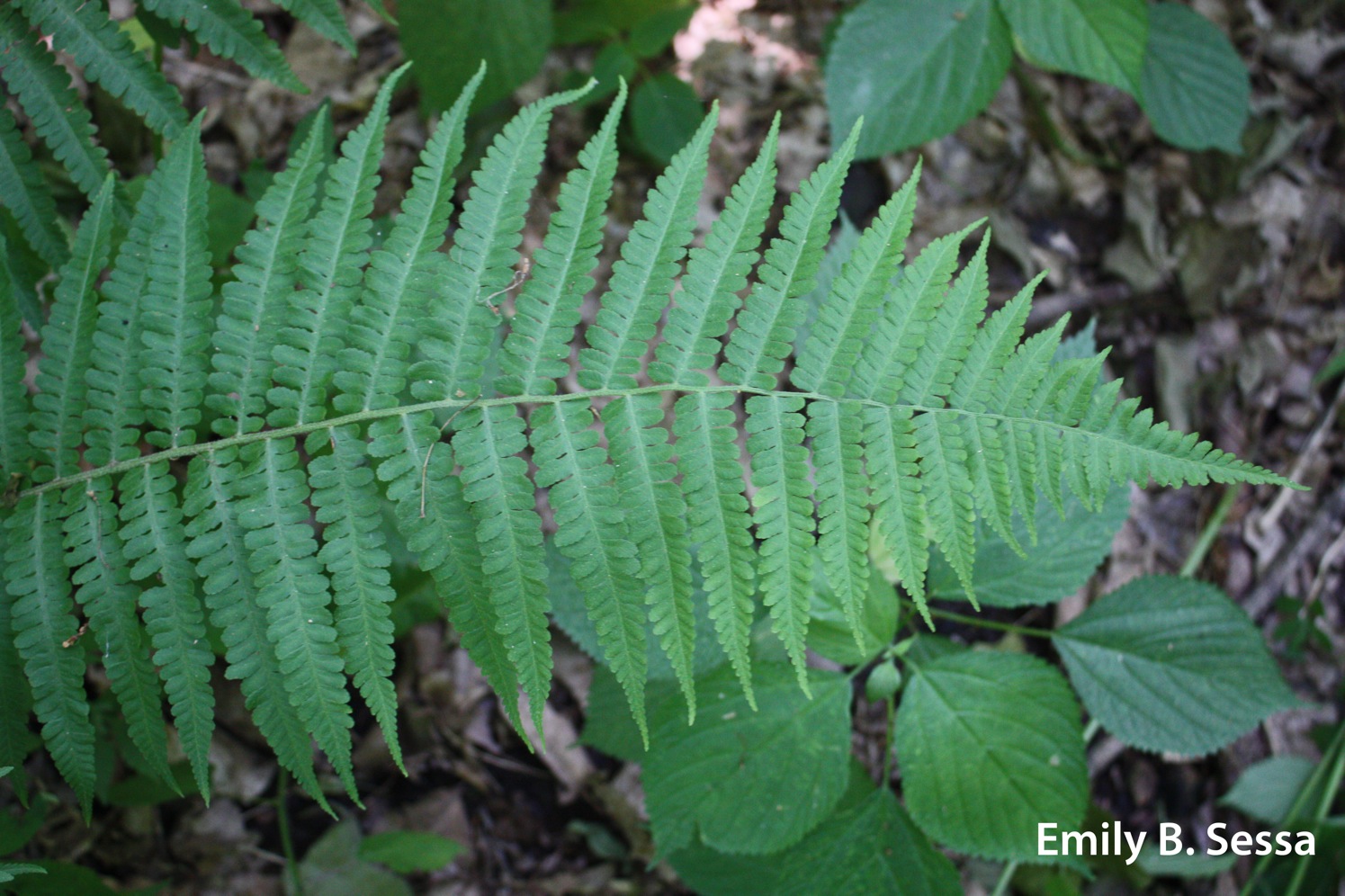
I mentioned in the post on Abraham's Woods ferns that we found a new species there (well, new for that site): Deparia acrostichoides, the Silvery Glade Fern. I got some better photos of it on a return trip and thought I'd share some more about how to identify this fern. It actually sort of resembles Dryopteris goldiana, which it grows right alongside. Both are twice pinnate, but a major difference is that the pinnule lobes of Deparia are blunted and round-ended, while the Dryopteris pinnules come to a point (see photos in previous post).


Another character is the hairs: as you can see in the photo below, Deparia has a dense covering of white hairs, which make it look decidedly fuzzy, and it has no real 'scales' to speak of:


This final shot is of the underside of a frond, which is where the sori should be. Strangely, though, I couldn't find a single frond in the entire population which was fertile. All the other ferns I've seen this year are fertile by now, although the sori are still immature, but this Deparia is totally lacking in reproductive structures. I can't find any information on when it becomes reproductive; maybe this species is just a late bloomer, so to speak. A late sporer? I will be visiting this site again in the next few weeks and I'll keep an eye on it. In any case, this genus is distinguished by having linear sori, similar to Lady fern, along the midveins (costules) of the pinnules.


Wednesday, June 8, 2011

Abraham's Woods Ferns


And finally, a return to ferns! In addition to all the beautiful early spring flowering plants at Abraham's Woods, there are a number of ferns as well. Last time I went there we only found Dryopteris goldiana and what looked like a small Cystopteris, but this time we found an abundance of ferns in the richest, moistest corner of the woods. Some of the most striking were the Maidenhair ferns (Adiantum pedatum) pictured above and below. I've mentioned before that this species tends to have reddish stipes, which turn a dark red to almost black when the plants are mature. You can certainly see the red color in these young plants, as well as the whitish hairs and small scales they bear.


No woodland would be complete without Lady fern, Athyrium filix-femina, and Abraham's Woods is no exception. Their stipes can be bright green to brown to red, while the blade is usually always a bright green color.


Other than Dryopteris goldiana, which I'll devote a future post to, the final fern we saw was Deparia acrostichoides, the Silvery Glade Fern or Silvery Spleenwort. The second common name is a relict from when this fern was placed in the Asplenium genus. This species actually isn't on the list for Abraham's Woods, so it was an exciting find. This fern is distinguished by the bluntness of the pinnule lobes, and by having a dense white fuzz of hairs all along the stipe and rachis, which you might just be able to make out in these photos...