Monday, July 21, 2014

Ferns in the Netherlands

I just returned from a month-long fern collecting trip through most of central Europe; it was fantastic and I brought back ~500 samples, both newly collected from the field and material sampled from herbarium specimens. All of these samples, which are from various Dryopteris and Asplenium species, will have DNA extracted, and then be included in sequencing projects to determine phylogenetic relationships in the two genera, the focus of a big project in my lab. I'll post pictures from the whole trip over the next few weeks. The itinerary included stops in the Netherlands, Paris, Turin and Sestri Levante in Italy, Ceske Budejovice in the southwestern Czech Republic, Bonn, Ghent, and Madrid.


We started the trip by spending a week in the Netherlands, based in Leiden. We visited the exceptional herbarium collections at the Naturalis Biodiversity Center, which houses collections from universities all over the Netherlands. Looking out over the collections from the second floor was like being in the warehouse at the end of Raiders of the Lost Ark:


In addition to sampling from material at the herbarium, we went on several field trips to collect fresh material from the field. Our host, Peter Hovenkamp, brought us to several beautiful sites in the northern part of the country, and we found a number of Dryopteris species, several of which are endemic to Europe and that I had never seen before.
Our collecting team: Arjen de Groot, my husband/field assistant, me, Aino Juslén, Peter Hovenkamp
Finding our first big Dryopteris affinis!
Dryopteris dilatata:

Dryopteris affinis:

Polystichum setiferum:

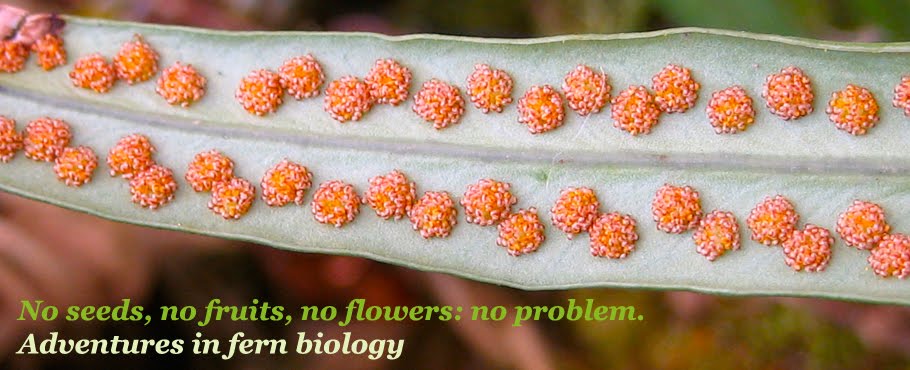
Some beautiful sori on several fertile species:
Dryopteris dilatata
Dryopteris affinis
Left: D. filix-mas, right: D. affinis. The indusium margins are a good way to tell them apart.
 Stream with Dryopteris affinis:

Asplenium scolopendrium:


 Dryopteris cristata:


Saturday, April 26, 2014

Splinter Hill Bog: Ferns!

Bracken and pine in a recently-burned section of the bog tract.
I've saved a post about the ferns of Splinter Hill Bog for last! We saw several species on our trip, in various stages of early spring loveliness. The common species included Osmundastrum cinnamomeum (cinnamon fern), Osmunda regalis (royal fern), Woodwardia virginica (Virginia chain fern), and of course the ubiquitous Pteridium aquilinum (bracken fern).
Woodwardia virginica
Pteridium aquilinum
Osmundastrum cinnamomeum
Osmunda regalis
Osmunda regalis
Osmunda regalis

Wednesday, April 23, 2014

Splinter Hill Bog: Drosera spp.

A cluster of Drosera capillaris, the pink sundew.
In addition to several species of pitcher plants, we also saw two species of Drosera, commonly called sundews, on our visit to Splinter Hill Bog. Drosera has always been one of my favorite plant genera; there is something really lovely about their little pads that always seem to be glistening with dew (though of course, it's not dew... it's insect-trapping glue). The two species we saw are both new to me, though one closely resembles the northern species I'm most familiar with, Drosera rotundifolia.

Drosera capillaris
Drosera capillaris
Drosera capillaris in flower
Drosera tracyi, the Gulf coast sundew
Drosera tracyi trying its best to look like a fern


Tuesday, April 22, 2014

Splinter Hill Bog: Sarracenia psittacina


The last of the pitcher plant species we encountered at Splinter Hill Bog was Sarracenia psittacina, the parrot pitcher plant, so named because of the shape of its pitchers. This species is much shorter than the others, and tends to have its pitchers appressed to the ground, rather than upright. It's easy to miss as it's much smaller, too. This one was not yet in flower when we visited.

Sarracenia psittacina and Lycopodiella inundata


Downward-facing hairs, characteristic of many carnivorous plants.
There are little translucent windows in the ends of the hoods to confuse light-seeking insects who will try to exit that way.


Saturday, April 19, 2014

Splinter Hill Bog: Sarracenia purpurea

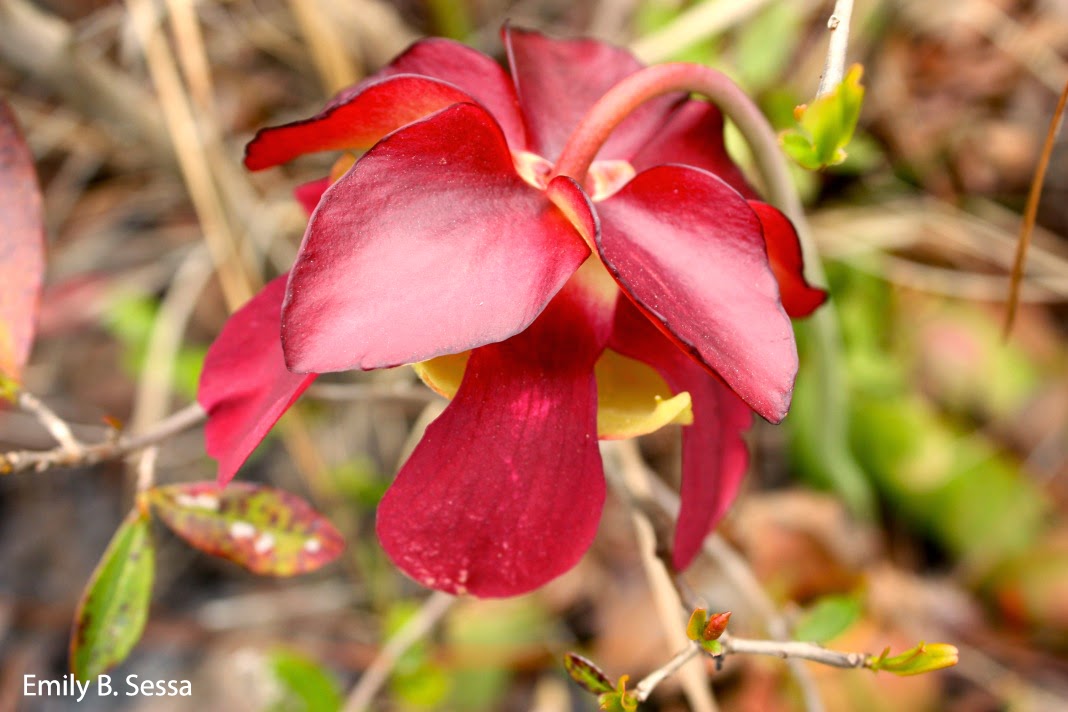
Purple pitcher plant, with yellow stigma/style
The second species of pitcher plants we saw at Splinter Hill Bog was the purple pitcher plant, Sarracenia purpurea ssp. rosea. This is a southern subspecies of the widespread species that's found in much of the eastern U.S. This plant differs quite a bit from S. leucophylla, the white-topped pitcher plant, particularly in the morphology of the pitchers. S. purpurea's pitchers are short, squat, and green to reddish in color, with none of the white pigment (or lack of pigment) that characterizes S. leucophylla.

Note the downward facing hairs, to help catch dinner